
23. propósito
How to read more (and a new project!)

I am opening 2026 with a confession: Despite working in publishing and having two literature degrees, there have been whole years in which I did not read a single book for pleasure. The reasons for this range from “fine” to “bad.” Between 2015 and 2021, I was really into podcasts and spent time when I might have been reading, like my commutes, listening to The Read, Chapo Trap House, Buffering the Vampire Slayer, The Black Tapes, Punch up the Jam, and Maintenance Phase. I was often tired and depressed, which meant I sought out media that used less brainpower, like TV binges.1 More than anything else, I scrolled, spending most of my free time toggling between Facebook, Twitter, or Instagram. This habit made me more tired, stressed, and depressed, creating a perfect feedback loop that led to more scrolling.
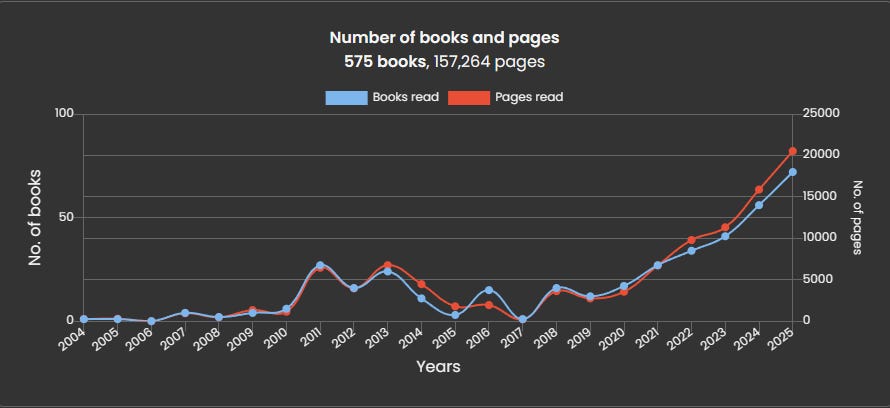
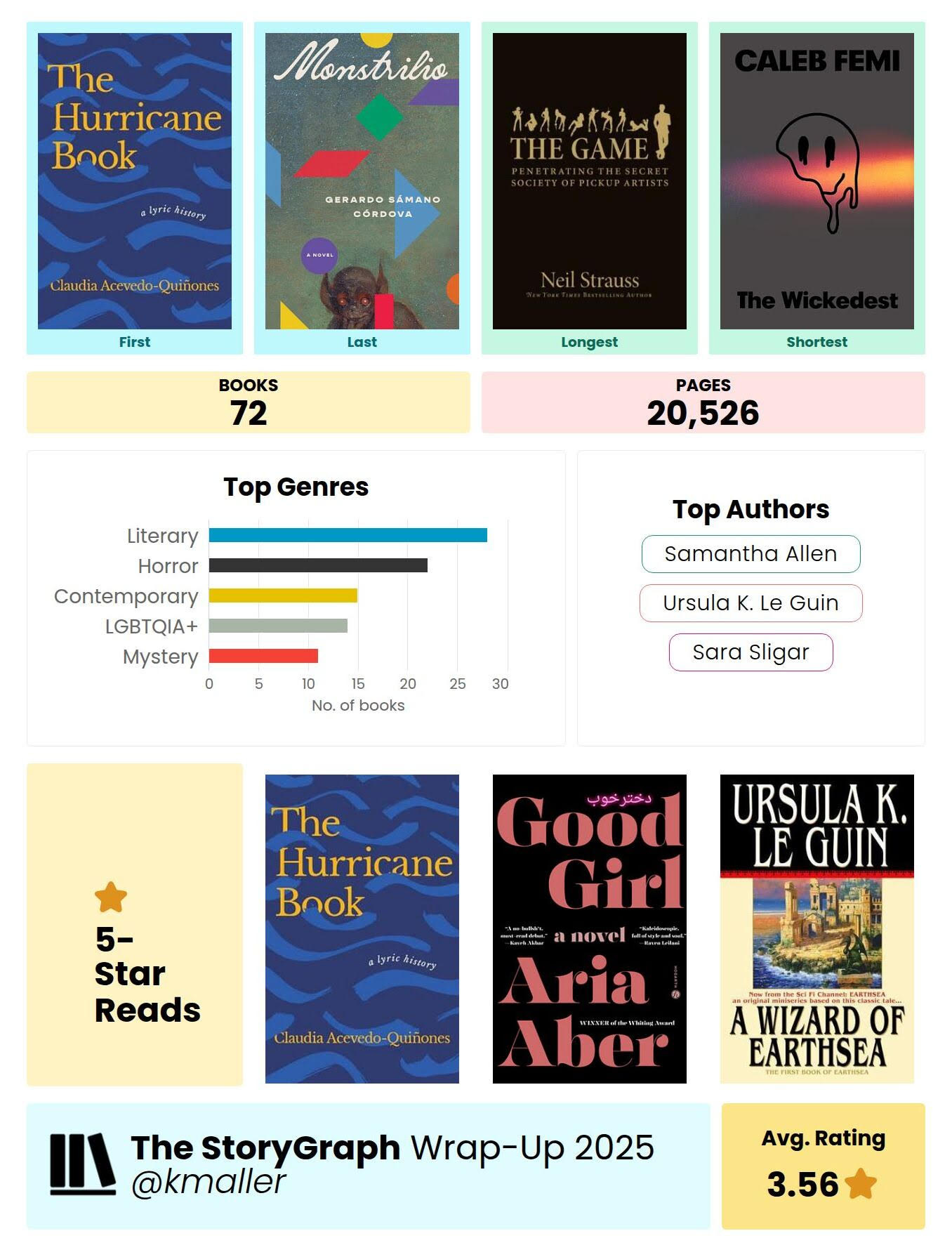
I set about changing this in 2018. I had just gotten out of a soul-sucking job and adopted Malta, and with so many positive changes happening at once, I decided it would be the year I finally stuck to my eternal New Year’s resolution (or propósito, in Spain): read more. I’ve kept this resolution year after year, simply because I don’t believe there’s ever a cap to how much one can read. I’ve read more each year since 2020, hitting a record that I’m extremely proud of in 2025: 72 books.
I know that many people want to read more, and like many New Year’s resolutions, they start the year with good intentions, only to give up a few weeks later. If that’s you, I’m here to share some tips that changed things for me and helped the habit stick.
1. Define your “why”
Sorry to borrow this phrase from the woo-woo corner of the internet, but it is true that nothing will stick if there’s no good reason for it. So ask yourself: Why do you want to read more? Do you remember loving books as a kid? Are you tired of streaming services assuming you’re stupid? Do you want to cut down on screen time or counteract the way that generative AI rots your brain? Are you looking for better sources of information?
This is not me interrogating whether reading more is a worthwhile goal—reading is good for you and society, point blank. But similar to an exercise program that fails because “it’s good for you” is not motivating enough, you need something to make your new reading practice stick, even if that something is “I want to get off.”
Initially, I longed for the way books used to make me feel. As a sad teen, I felt seen by Edgar Allan Poe, and I was taken by fantasy series like Sweep and Daughters of the Moon. In college, I came to understand racism, sexism, classism, and imperialism through authors like James Baldwin, Clarice Lispector, Toni Morrison, Octavia Butler, and Margaret Atwood. My senior year, I read The Blind Assassin and burst into tears at the end, feeling like I had lived an entire lifetime with Iris. What a contrast from social media, which ultimately makes me feel empty. A new benefit I’ve noticed since reading more is that it makes me a better writer. I am more creative, more attuned to my own voice, and more precise.
2. Find your genres
Once you figure out why you want to read, a road map starts to form. If you want higher quality entertainment, then you should be seeking out fiction. If you’re more information-oriented, start with nonfiction. The most important thing here is to distinguish between the books you want to read and the books you think you should read.
I think this is where a lot of people get stuck. They didn’t like the books they were assigned in high school, so they think reading is always a chore. Or they heard one too many business idiots claim that fiction is a waste of time, so they try to force themselves through nonfiction books they’re not actually interested in. Or they get analysis paralysis when confronted with the thousands of books in a bookstore (or the billions available online).
Figuring out what I liked to read unlocked everything for me, and something that helped me do that is LitHub’s annual “Most Anticipated Books” list. I bookmark this every January and read through the synopses as the year progresses, seeing what grabs me. Their list skews literary, but it’s not all lit fic—nonfiction of all kinds, plus thrillers, horror, romance, fantasy, and mysteries, always make the cut. If you’re not vibing with LitHub, ask your friend with impeccable taste, check out the book reviews in a magazine you like, or dip a toe into BookTok to see what sparks your interest.
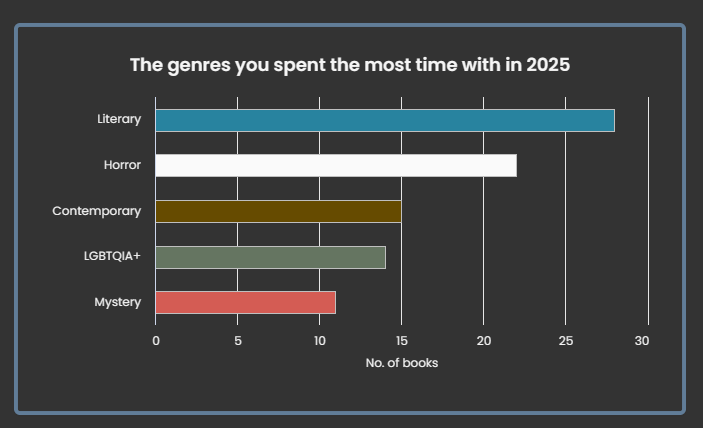
LitHub helped me hone in on what I wanted to read: weird girl literary fiction, literary horror and sci fi, and queer novels. I’ve already added a ton of books from this year’s list to my TBR, including they by Helle Helle, Murder Bimbo by Rebecca Novack, and Waiting on a Friend by Natalie Adler (who I am lucky to know in real life—read your friends’ books!!)

3. Get a library card
Has this ever happened to you? You go to a cute brick and mortar bookstore and spend an hour browsing, getting drawn in by beautiful covers, matte finishes, or handwritten staff recommendations? You thought maybe you’d buy one book but you’ve ended up with a stack of five, and then you go to the counter and they ring you up for $100+? On the train home, you start reading one of them but can’t focus on the content because you’re just thinking, “Wow, look at me, reading on the train”? Only to get home, shelve the books, and never touch them again?
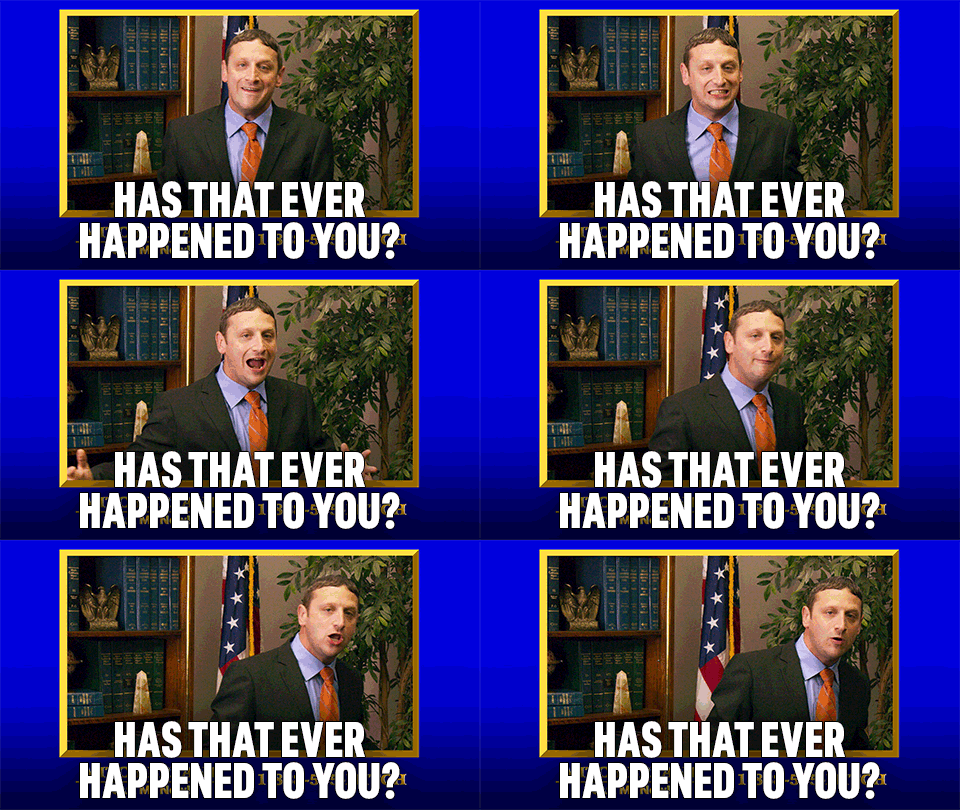
Some tough love: Buying books is not the same as reading books. If you’re someone who can buy a book and read it before buying the next one, then this tip is not for you. For everyone else: Sign up for a library card.
The library is probably the number one reason that I read as much as I do now. For one, deadline-oriented reading works for me. I have infinite time to read the books I already own, which means that I will never read them. If I only have two weeks to read something, I’m going to read it, especially if I waited a few weeks before it was my turn to borrow it.
Joining the library also gives you infinite space for experimentation. I am not rich, which means that buying books always felt a bit high-pressure to me—I wanted to make sure I was buying the “right” books, and when I did read them, I would push through them even if I didn’t like them to get my money’s worth. A library card gives me permission to stop reading books I’m not enjoying, which means that reading never feels like a slog. I can also read more books than I could ever afford to buy in a single year, and I can experiment with genres or formats. If you’ve been curious about audiobooks, the library is a great way to try them! If you like genres that you find a little embarrassing, a digital loan delivered straight to your e-reader lets you read them in peace.
“But Katharine,” you say, “how are authors supposed to get paid if I’m not buying their books?” Unlike illegal downloads, libraries pay for books, e-books, and audiobooks, which means that authors earn royalties on them. The pricing models for digital content are not great deals for libraries since they pay per license, but it does mean that the author is compensated whenever a digital version of their book is borrowed. And even with this imperfect pricing model, borrowing supports the library because budgets are partly determined by usage statistics. So support authors and libraries by using libraries! You can always use the money you saved to buy a copy of any book you borrowed and loved.
Speaking of library services:
4. Delete your apps and download Libby
This is perhaps extreme, but if your goal is to stop doomscrolling, I can’t recommend it enough. I’ve been slowly deleting social media apps from my phone for years, beginning in 2016 when Trump was elected and I would bedrot while looking at Facebook every morning. Quitting Facebook was liberating at the time, but I shifted my nervous energy over to Instagram and Twitter instead. I eventually quit Twitter when Elon Musk bought it, and I abandoned TikTok after Trump banned and “saved” it. I now only use Instagram and Bluesky on desktop, which limits their usefulness and their hold over my life.
I would be lying if I said I don’t miss social media. I have a wistful kind of yearning for the early days of Instagram when we put Valencia filters on our photos, and despite everything, I fucking loved Twitter. I am still friends with people I met on Twitter. It was an incredible way to learn about the world and politics. I am sad that it’s gone forever and angry that it got turned into an AI/white supremacy/child pornography slop machine.
All of this to say: I get why we scroll. It feels good, and it can help us feel connected to the world. If you’re trying to wean yourself off social media, the Libby app is a lifesaver. Whenever you pick up your phone, looking to fill the urge to scroll, it means that there’s something you can open that’s more enriching. When I found out that I could subscribe to magazines through my library’s Libby interface, it was a game-changer. All those viral The Cut articles that are locked behind a paywall? They’re often in the magazine! You can read them for free through your library! Twitter used to keep me abreast of the latest reporting, long-form journalism, and think pieces, but in its absence, reading magazines through Libby scratches that itch.
5. Read before bed
Or on the train, or before work—pick something you do every day and dedicate some time beforehand to reading. This ensures that you do it every day, even if its only for a few minutes before you start to fall asleep or the train reaches your station. If you’re like me, it will change over time from a thing on your to-do list to an activity you crave. You might find yourself getting into bed earlier, excited to read what happens next.
Before you go, I have one more propósito to share with you: I want to start a second newsletter this year. Lost Mixtapes will be an interview series and a space that reveres analog art and human connection. To learn more, read my call for interviewees.
Song of the Month:
My 2025 obsession was Buscabulla, the Puerto Rican duo who are probably most famous for collaborating with Bad Bunny on 2022’s “Andrea.” “11:11” sets dreamy vocals against a merengue-influenced, clubby, indie-pop beat. It’s about having the courage to do something meaningful with your life rather than being caught in the grind: “Pa’lante, sin miedo / Que hoy vengo con todos los hierros / Porque yo me lo mеrezco.”
Hasta Luego,
—Kata
In before the TV folks get mad—I love TV, but that doesn’t mean that every TV show is brain food.
Libby is such a lifesaver 🥰